What your brand should have done 90 days before admissions open.
Posted by ABND on June 30, 2026
Every year, somewhere around the second week of January, education institutions across India enter what is internally called “admissions mode.” Social media picks up. The design team is suddenly very busy. A new batch of creative is briefed. The principal’s schedule fills up with open days. And every year, the results are more or less what you would expect when a brand is switched on like a tap for four months and then switched off again.
Admissions marketing works best when it is spending brand equity that was built over the previous eight months. Most institutions are instead trying to build and spend at the same time. That is a fundamentally exhausting and expensive way to run an education brand.
The 90 days before admissions open are not preparation time. They are the brand payoff period, the preparation should have started before that. But since most institutions have not done that, let us talk about what needs to happen in those 90 days to give yourself the best possible chance.
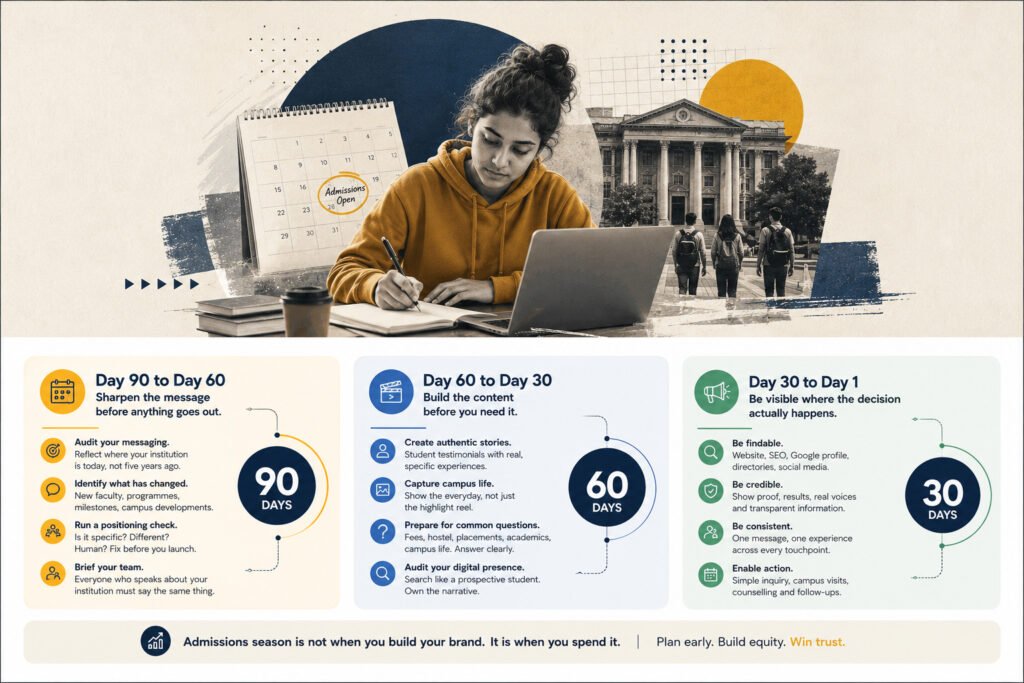
Admissions season is not when you build your brand. It is when you spend it. If you are building during season, you are already behind.
Day 90 to Day 60: Sharpen the message before anything goes out
The instinct in most institutions at this point is to get things moving. Book the ads, launch the campaign, put something up on social media. The instinct is wrong.
The most valuable thing you can do in the first month of your 90-day window is audit what you are actually saying and whether it reflects where your institution is today. Not five years ago, not when the brochure was last updated. Today.
What has genuinely changed in the last 12 months? New faculty, new programmes, a new campus feature, a placement milestone, a shift in your academic philosophy? These are your freshest brand assets and most institutions do not deploy them because they have not been written into the narrative before the campaign launches.
Run a quick version of what we call a positioning check: hold your current messaging against the three questions that actually matter to your target student and parent. Is this specific enough to be believed? Is this different enough to be chosen? Is this human enough to be trusted? If any of those three answers is no, fix the message first. Running a campaign on weak positioning just gets you to your own inadequacy faster and at higher cost.
This is also the window to brief your team on the message. Faculty who do not know what the institution is saying about itself this year will say something different when a parent calls or a prospective student sits across from them. Brand consistency is not a marketing department problem; it is a people problem. Fix it before the traffic starts.
Day 60 to Day 30: Build the content before you need it
Most admissions campaigns run out of content by February. Not budget. Content. The creative that was shot in a rush looks dated by week six. The testimonials are the same three students from last year. The social media manager is recycling infrastructure photos with different filters. This happens because content is treated as something you produce during the campaign, when it should be produced before the campaign starts.
The 30-day window from day 60 to day 30 is when you should be building everything you will need for the full admissions arc. That means student testimonials that go beyond “the faculty is very supportive” into actual, specific stories. It means campus content that captures the texture of daily life, not just convocation photographs. It means a small library of short-form video that a prospective student might actually share, not just watch once.
It also means preparing for the questions you know are coming. Every admissions cycle has the same questions: fee structure, hostel quality, placement outcomes, competitive environment, what students actually do outside the classroom. Build clear, honest, well-designed answers to these before you are being asked them at scale. An institution that has a crisp, confident answer ready is a different brand experience from one that says “please send your query to info@.”
This is the point to also think about your digital presence with fresh eyes. Do a search for your own institution the way a prospective student would. What comes up? What does it say about you? Is the review ecosystem broadly positive or is there a conversation happening that you are not part of? Your brand in the digital environment is whatever the internet currently says about you, not whatever your prospectus says.
A campaign without a content library is like a restaurant that takes bookings before hiring a chef. Busy is not the same as ready.
Day 30 to Day 1: Be visible where the decision actually happens
By the time you are 30 days out, the heavy lifting on brand and content should be done. This final window is distribution and presence. It is making sure that wherever your prospective student and their parent are looking, they find something useful.
What that means in practice depends heavily on which segment you are in. A K-12 school in a metro is working very differently from a professional college in a Tier 2 city. But the underlying principle is the same: be findable, be credible, and be consistent.
Credible means there is evidence behind your claims. Not just claims. Not “we offer holistic education and nurture tomorrow’s leaders.” Evidence. A specific placement outcome. A faculty credential that is genuinely impressive. A student project that won something real. A community that is visibly proud of their institution. Claims without evidence are just noise; the admissions market in India has a very well-tuned noise filter.
Consistent means the same story is being told across every touchpoint. The message a parent hears at an open day is the same message they read in the email, the same one the student ambassador says, the same one the social media reflects. When these diverge, trust falls. And trust is very hard to rebuild inside a 90-day window.
Treat open day as a brand experience and not a presentation.
Most institution open days are presentations wearing the costume of an experience. There is a stage, a PowerPoint, a welcome address, a panel, a campus tour, and some food. Parents tick a mental box and move on to the next one
The open day is actually your single highest-leverage brand moment in the admissions cycle. The person in that room has self-selected. They are already interested. Your job is not to present; it is to convert interest into emotional commitment. That requires a very different event design
The open day is actually your single highest-leverage brand moment in the admissions cycle. The person in that room has self-selected. They are already interested. Your job is not to present; it is to convert interest into emotional commitment. That requires a very different event design
Nothing converts a prospective student faster than meeting a current student who genuinely loves where they are studying. Nothing kills a conversion faster than an open day that feels like a sales pitch.
What happens if you have not done any of this
If you are reading this and it is already 30 days before admissions open and none of the above has happened, you have two choices.
One is to run the campaign anyway and accept that you are spending money to reach a brand that is not ready to receive it. You will get some applications, because the market always produces some applications, but your conversion rate will be softer than it should be and you will not know why.
The other is to do a fast, focused version of the work that matters most. That means getting the core message right immediately, shooting a small amount of genuine, usable content this week, and making sure your digital presence at minimum does not actively work against you. It is not the same as having done it properly from September. But it is significantly better than nothing.
The uncomfortable truth about admissions marketing is that the institutions consistently achieving strong enrolment numbers are not doing dramatically more creative work. They are doing the same work, earlier and with more clarity about what they are saying and to whom.
The institutions that win admissions cycles are not the ones who launch the most memorable campaign in January. They are the ones who have been building quietly since September.
The deeper problem worth solving
The 90-day frame is useful, but it is treating a symptom. The real issue is that most Indian educational institutions run their brand on an annual campaign cycle rather than as a continuous asset.
A brand that is only active during admissions season is not a brand. It is a campaign. The 90 days before admissions open should feel like a comfortable sprint, not a scramble. If it feels like a scramble, something in the operating model of the brand is wrong. That is worth fixing before next year.
Edunoia’s LaunchPad and Re:Fresh programmes are built to solve exactly this problem. If your institution is heading into an admissions cycle and the brand does not feel ready, that is the conversation to start now.