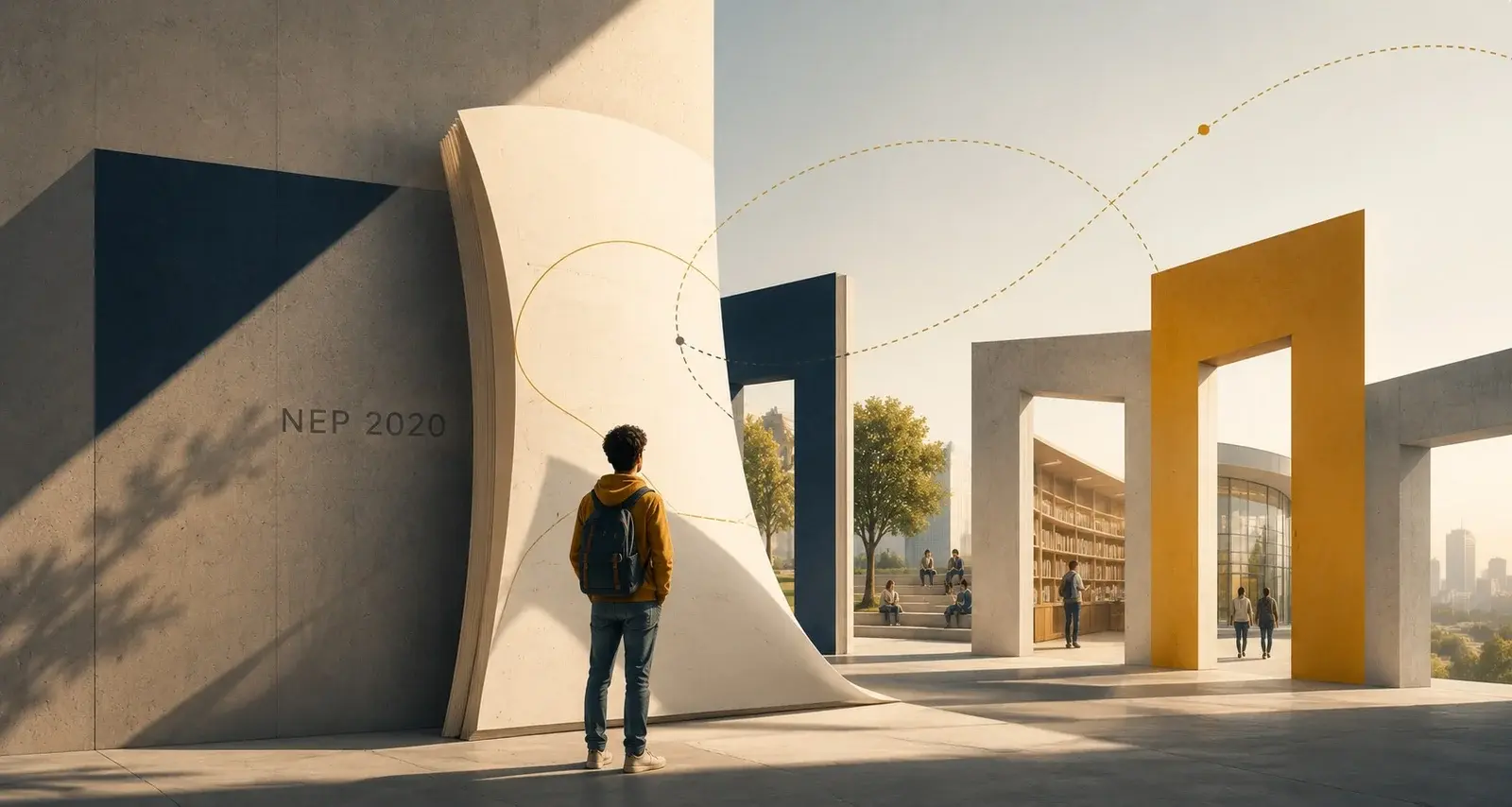
With NEP 2020 India rewrote the rules of higher education which many institution brands did not notice.
Posted by ABND on June 30, 2026
When NEP 2020 was announced, the education sector in India did what it usually does with landmark policy: argued about it for a while, then started quietly implementing it.
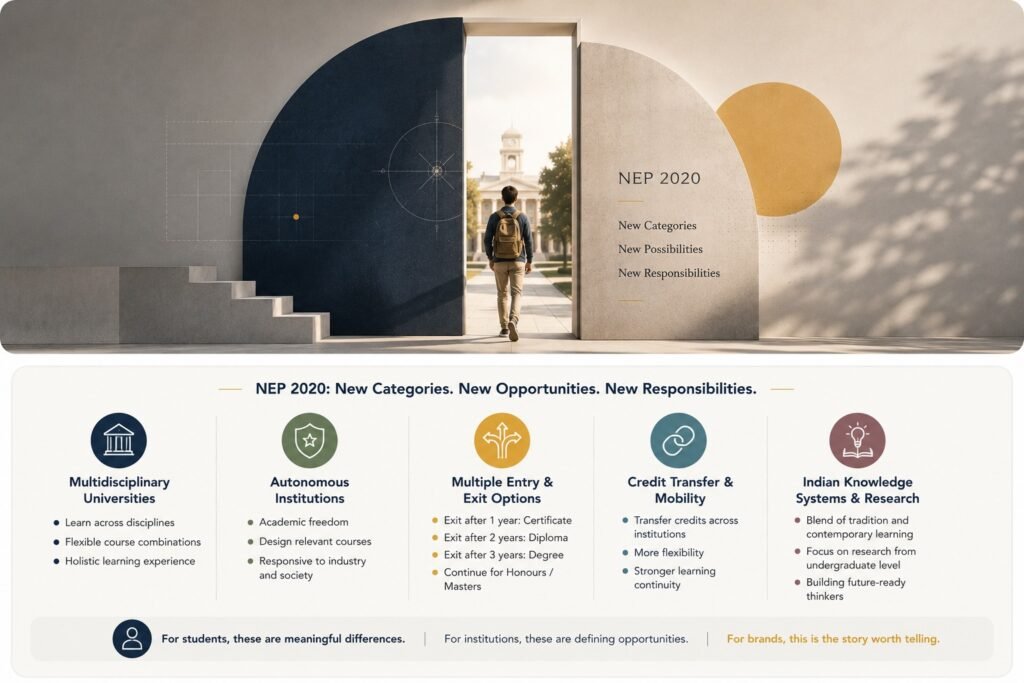
Institutions filed the paperwork, curriculum teams started restructuring programmes, academic councils met, regulatory boxes were ticked and gradually, institutions found themselves reclassified into new categories, Multidisciplinary Universities, Autonomous Institutions, Higher Education Institutions with multiple exit options, Institutes of Eminence, and so on.
What almost none of them did was tell their brand, and the brand is still out there, on the website, on the prospectus, in the social media bio, saying the same thing it said in 2018.
Why this matters more than it sounds
NEP 2020 is not a minor curriculum update. It is a structural rethinking of what an Indian educational institution can be. The policy introduces concepts that did not exist in formal Indian higher education before: multidisciplinary learning, flexible exit with degree or diploma, credit transfer between institutions, integration of vocational and academic streams, Indian Knowledge Systems alongside contemporary content, and a genuine push toward research culture at the undergraduate level.
For students and parents trying to choose an institution, these are meaningful differences. A university that genuinely operates as multidisciplinary, where a student can combine economics with data science with design, is a different value proposition from one that simply added two electives to a traditional three-year degree. An institution that has built real credit transfer partnerships offers something genuinely portable. One that has not is using the language without the substance.
But the problem is most institutions are using the same language regardless of which camp they fall into and students cannot tell the difference.
NEP created real distinctions between institutions. The brands of those institutions have not caught up. Everyone sounds the same.
The communication gap is enormous
Spend twenty minutes reading the websites of Indian universities and colleges that have implemented NEP 2020 frameworks and you will notice something. Almost all of them mention NEP 2020 compliance somewhere. Very few of them explain, in plain language that a 17-year-old can understand, what that compliance actually means for the student’s experience.
“NEP 2020 aligned curriculum” tells a prospective student almost nothing. It sounds like a checkbox. “You can graduate with a BSc after three years, complete your fourth year for an Honours degree, or stay for a fifth year to finish an integrated Masters, and your credits from here are transferable to four partner universities” tells them something genuinely useful
The difference between those two statements is not just communication style. It is the difference between a brand that understands its own offer and one that is signalling compliance without explaining value.
This gap exists because policy implementation and brand communication are typically handled by completely different parts of an institution that rarely talk to each other. The academic team implements the curriculum changes. The marketing team runs the admissions campaign. The two conversations never converge into a coherent story.
New categories, new brand questions
NEP 2020 created categories that carry genuine brand implications if institutions are willing to own them.
Multidisciplinary Universities
If you are genuinely multidisciplinary, you can make a brand claim that no traditional single-faculty university can match: “you do not have to choose at 17.” That is a powerful message in a culture where students are under enormous pressure to pick a lane early and stick to it. But it only works if the institution has actually built the infrastructure for it, advising systems, credit structures, faculty who teach across departments, genuine exposure to multiple fields. Claiming multidisciplinarity without building it is a brand promise that will be broken every time a student tries to act on it.
Autonomous Colleges with New Freedoms
Autonomy under NEP means the ability to design courses without being completely constrained by university syllabus. For an institution that has strong faculty and genuine academic ambition, this is a brand moment. “We design our own courses based on what the industry and the world actually need” is a meaningful positioning that many autonomous colleges are failing to deploy because they are still writing about their affiliations.
Institutions with Multiple Entry and Exit Options
The flexible exit framework is perhaps the most student-relevant structural change in NEP. A student can exit after one year with a certificate, after two with a diploma, after three with a degree. This matters enormously to students from families where continued education is financially uncertain. Communicating this well is a brand opportunity and a genuine service to the students who most need to hear it. Almost nobody is doing it clearly.
The most powerful brand claim available to a genuinely multidisciplinary institution is also the simplest one: you do not have to choose at 17.
The institutions that get this right will build durable differentiation
India is heading toward a period of increased institutional competition. The GER targets mean more universities, more colleges, more EdTech options, more international campuses setting up shop. In this environment, differentiation is not optional; it is survival.
The institutions that will win are the ones that have done two things: genuinely implemented the structural changes NEP enables, and built brand positions that clearly own those changes.
Consider the analogy of the airline industry, which went through a similar structural shift when liberalisation changed what airlines could offer. The ones that built clear brands around their new capabilities, full-service versus budget versus experience, built durable customer relationships. The ones that changed their operations but kept the same brand positioning created confusion.
Education is not an airline. But the principle holds. When the market structure changes, brand strategy has to follow. In Indian higher education right now, the market structure has changed significantly. The brand strategies of most institutions have not moved at all.
What rebranding for NEP actually involves
It does not mean a new logo. It does not mean rewriting the tagline and calling it done.
Rebranding for NEP alignment means going back to basics: what has genuinely changed about what this institution offers, and what does that change make possible for a student that was not possible before? Then it means finding the clearest, most honest language to communicate that. Then it means making sure that language is consistent across every touchpoint, from the first digital impression to the open day to the way faculty introduce themselves in the first week of class.
It also means being honest about what has not changed. An institution that has NEP 2020 compliant paperwork but has not actually restructured its learning experience is not a multidisciplinary university. It is a traditional institution with updated forms. Claiming otherwise is a brand promise that will be broken and that is worse than making no claim at all.
The brand strategy exercise here is about finding the genuine differentiation that NEP has made possible for your specific institution and building the communication architecture around that. Not the generic differentiation that every institution can claim. Your specific version of it.
The window will not stay open
There is a window right now where institutions that move fast can own NEP-related positioning before it becomes generic. Once every institution has updated its brochure to say “NEP 2020 aligned,” the phrase will be as meaningless as “holistic education.” The institutions that have built specific, credible, evidence-backed positions around what NEP actually enables for their students will have something that cannot be easily copied.
That window is probably 18 to 24 months. Some institutions have already started moving. Most have not.
The question is not whether NEP 2020 changes your institution’s brand story. It clearly does. The question is whether your institution is going to write that story or leave it for prospective students to misunderstand.
Edunoia works with schools, universities, and EdTech institutions to translate policy and structural change into brand positions that students and parents actually understand. If NEP 2020 has changed what your institution offers, your brand should reflect that.